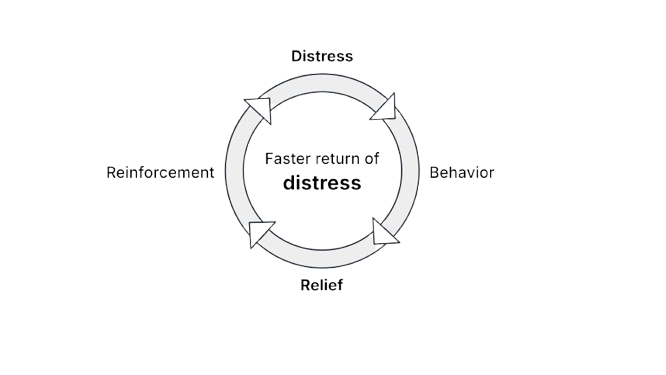
The Relief Loop

The Relief Loop is a framework for understanding why humans repeat behaviors that temporarily reduce distress, even when those behaviors create suffering over time.

The goal is often not pleasure.

The goal is relief.

This pattern can appear in addiction, burnout, compulsive behavior, emotional avoidance, perfectionism, overworking, control, reassurance seeking, and many other human experiences.

Why This Matters

Many people interpret repeated behaviors as weakness, lack of discipline, or failure.

The Relief Loop offers another perspective:

Behaviors often make sense in the context of learned relief.

Over time, the brain learns which behaviors temporarily reduce distress and begins to repeat them more automatically, especially during moments of uncertainty, emotional discomfort, fear, or overwhelm.

Understanding the loop does not remove responsibility. But it can reduce shame and create space for awareness, change, and new learning.

The Relief Loop Can Appear In

  • Addiction

  • Burnout

  • Perfectionism

  • Emotional avoidance

  • Anxiety and worry

  • Compulsive checking

  • Reassurance seeking

  • Overworking

  • Rumination and overthinking

  • Control behaviors

  • Emotional withdrawal

  • Scrolling and digital overuse

  • Many other repetitive human behaviors

Relief vs. Pleasure

Many repetitive behaviors are misunderstood as attempts to feel good.

Often, they are attempts to stop feeling bad.

Over time, the brain learns not only the relief itself, but the anticipation of relief. The behavior begins to occur earlier and more automatically, especially during distress or uncertainty.

The loop gradually narrows flexibility, reinforces avoidance, and can deepen suffering over time, even when the behavior initially helped.

The Staying Practice

Change does not always begin with force, suppression, or control.

Sometimes it begins with learning to remain present with experience long enough for new learning to occur.

Awareness creates space.

And space allows for different choices over time.

The Neuroscience Behind the Relief Loop

The Relief Loop is informed by several well-established concepts in neuroscience and behavioral learning.

Reinforcement Learning

When a behavior temporarily reduces distress, the brain becomes more likely to repeat it in the future.

Over time, the nervous system begins learning not only the relief itself, but the sequence that led to it.

Predictive Processing

The brain is constantly attempting to predict and minimize discomfort, uncertainty, and perceived threat.

As behaviors become associated with relief, the brain begins anticipating relief before the behavior even occurs. This can create urges, impulses, and automatic behavioral patterns during moments of distress or uncertainty.

Habit Formation

Repeated relief-seeking behaviors gradually become more automatic and less conscious, especially under stress.

What initially begins as a deliberate coping strategy can eventually become a deeply conditioned behavioral response.

Allostasis

Repeated cycles of distress and relief can alter the nervous system itself.

Distress may begin to return more quickly, feel more intense, or require increasingly frequent behaviors to temporarily reduce it.

The loop narrows flexibility and reinforces survival-based responding, even when those behaviors ultimately deepen suffering.

What Begins to Interrupt the Loop?

The Relief Loop is not a moral failure or a sign of weakness.

It is a learned pattern of responding to distress.

And like many learned patterns, it can change.

Interrupting the loop often does not begin with force, suppression, or self-criticism.

It begins with awareness.

With noticing the urge before the behavior.

With learning to remain present with discomfort, uncertainty, emotion, or vulnerability long enough for new learning to occur.

Over time, the nervous system can begin developing greater flexibility and tolerance for difficult internal experiences without immediately needing to escape them.

This process may involve:

  • Awareness

  • Emotional tolerance

  • Nervous system regulation

  • Pausing before automatic behavior

  • Naming internal experience

  • Connection with others

  • Self-compassion

  • Learning to stay rather than immediately escape

The goal is not perfection.

The goal is gradually creating more space between distress and automatic response.

Clinical Perspective

The Relief Loop emerged through years of work in Emergency Medicine, Addiction Medicine, and personal experience observing how humans respond to distress, uncertainty, emotional pain, and survival.

While the behaviors may differ, the underlying pattern is often remarkably similar:

Distress.
Relief-seeking.
Temporary relief.
Reinforcement.

Understanding these patterns through a neuroscience-informed and compassionate lens may help reduce shame while creating space for awareness, flexibility, and change.